
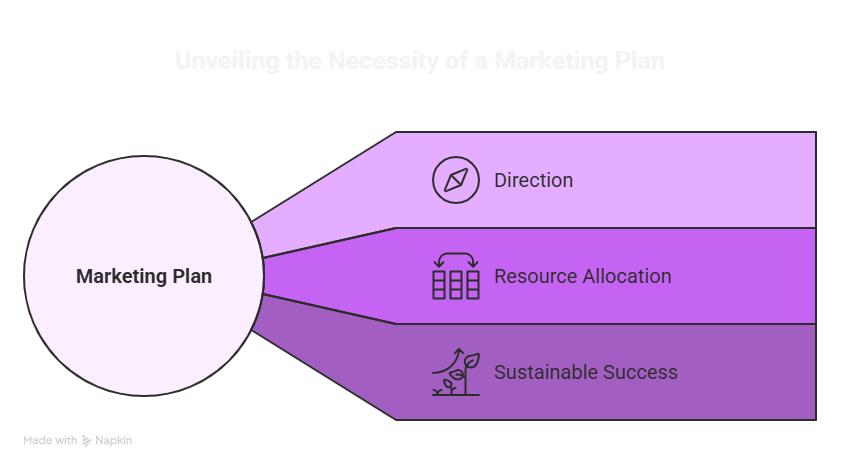
In today’s dynamic and competitive business landscape, a well-defined marketing plan is no longer a luxury but a necessity for survival and growth. This document outlines the critical reasons why your business needs a marketing plan today, emphasizing its role in providing direction, optimizing resource allocation, and ultimately achieving sustainable success.
Clarity and Direction
A marketing plan provides a clear roadmap for your marketing efforts. Without a plan, your marketing activities can become scattered and ineffective, leading to wasted resources and missed opportunities. A well-structured plan defines:
-
Target Audience: Who are you trying to reach? Understanding your ideal customer is crucial for tailoring your message and choosing the right channels.
-
Marketing Objectives: What do you want to achieve? Are you aiming to increase brand awareness, generate leads, or drive sales? Clear objectives provide a benchmark for measuring success.
-
Marketing Strategies: How will you achieve your objectives? This involves outlining the specific tactics you’ll use, such as content marketing, social media marketing, email marketing, or paid advertising.
-
Key Performance Indicators (KPIs): How will you measure your progress? KPIs allow you to track the effectiveness of your marketing efforts and make adjustments as needed.
Efficient Resource Allocation
A marketing plan helps you allocate your resources effectively. By understanding your target audience, objectives, and strategies, you can prioritize your marketing activities and invest in the channels that are most likely to deliver results. This includes:
-
Budgeting: A marketing plan helps you allocate your budget strategically, ensuring that you’re not overspending on ineffective channels.
-
Time Management: By prioritizing your marketing activities, you can allocate your time more efficiently and focus on the tasks that will have the biggest impact.
-
Team Alignment: A marketing plan ensures that everyone on your team is working towards the same goals and understands their roles and responsibilities.
Competitive Advantage
In a crowded marketplace, a marketing plan can help you stand out from the competition. By understanding your competitors’ strengths and weaknesses, you can identify opportunities to differentiate your business and create a unique value proposition. This includes:
-
Market Analysis: A marketing plan involves analyzing the market to identify trends, opportunities, and threats.
-
Competitive Analysis: Understanding your competitors’ marketing strategies can help you identify gaps in the market and develop a more effective approach.
-
Differentiation: A marketing plan helps you define your unique selling proposition (USP) and communicate it effectively to your target audience.
Measurable Results and Accountability
A marketing plan allows you to track your progress and measure the effectiveness of your marketing efforts. By setting clear KPIs and monitoring your results, you can identify what’s working and what’s not, and make adjustments as needed. This includes:
-
Data-Driven Decision Making: A marketing plan encourages you to make decisions based on data rather than gut feeling.
-
Accountability: By setting clear objectives and KPIs, you can hold yourself and your team accountable for achieving results.
-
Continuous Improvement: A marketing plan is not a static document. It should be reviewed and updated regularly to reflect changes in the market and your business.
Adaptability and Resilience
The business environment is constantly changing. A marketing plan provides a framework for adapting to these changes and remaining resilient in the face of challenges. This includes:
-
Flexibility: A marketing plan should be flexible enough to accommodate changes in the market, such as new technologies, emerging trends, or shifts in consumer behavior.
-
Contingency Planning: A marketing plan should include contingency plans for dealing with unexpected events, such as economic downturns or natural disasters.
-
Innovation: A marketing plan should encourage innovation and experimentation, allowing you to test new ideas and adapt your strategies as needed.
In conclusion, a marketing plan is an essential tool for any business that wants to succeed in today’s competitive marketplace. It provides clarity and direction, optimizes resource allocation, creates a competitive advantage, ensures measurable results and accountability, and fosters adaptability and resilience. By investing in a well-defined marketing plan, you can increase your chances of achieving your business goals and building a sustainable future.